
A Practical On-Page SEO Checklist for Small Business Websites
Many small business owners think SEO is complicated or highly technical.
In reality, a large part of SEO simply comes down to how clearly your website communicates what you offer. This is what on-page SEO is about.
Think about a small bakery in a town center. The owner might make excellent sourdough bread and beautiful custom cakes, but if the website just has a page called “Products” with a few photos and no clear description, search engines have very little to work with.
Someone searching for “custom birthday cakes in [name of town]” will probably never find that bakery.
But if the website clearly explains its services, uses descriptive page titles, and answers common customer questions, it becomes much easier for search engines and AI to understand and recommend it.
And search visibility is no longer limited to Google. Content is also discovered through AI tools, voice assistants, and platforms that summarize information directly from websites.
The good news is that the SEO fundamentals still apply. A clear, helpful, well-structured page performs better everywhere.
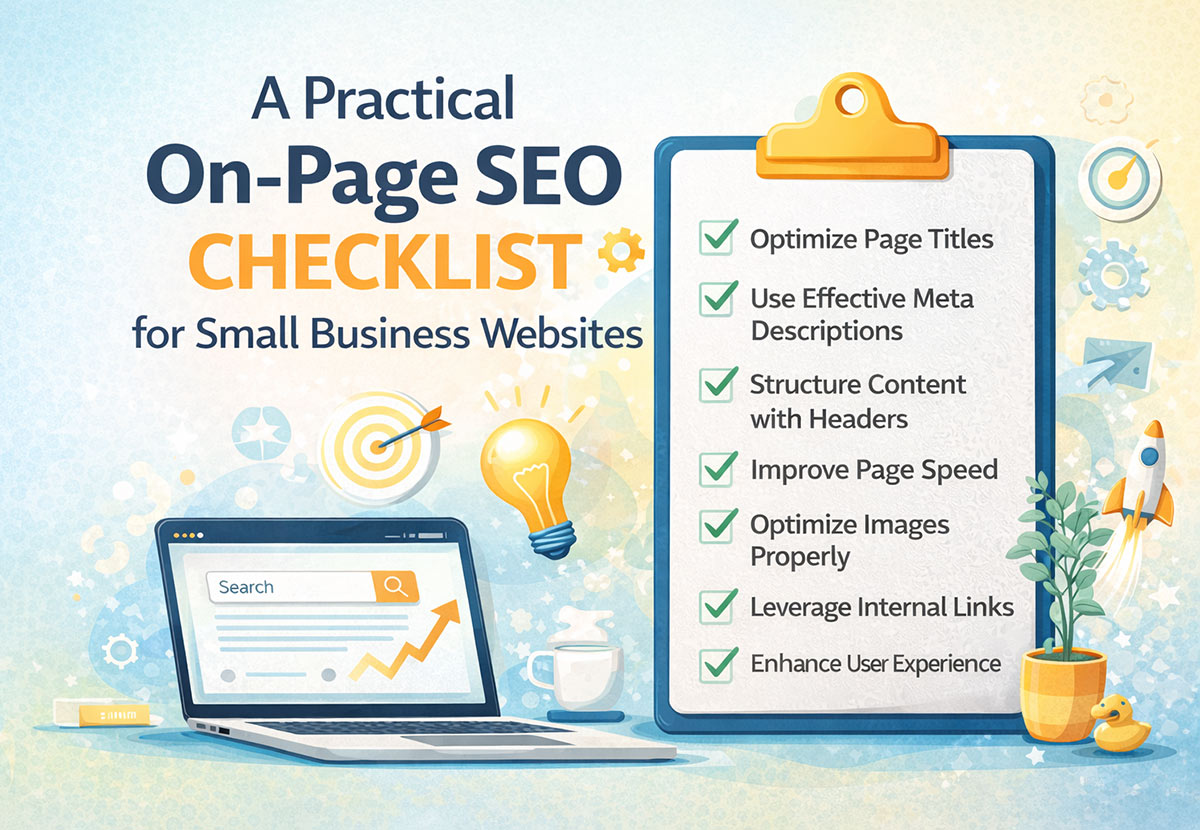
Below is a practical on-page SEO checklist that small business owners can use to improve their website.
On-Page SEO Checklist: 10 Things to Do
1. Start With One Clear Keyword Focus
Every page on your website should focus on one main topic.
Imagine our bakery again. If the same page tries to rank for bread, cakes, catering, baking classes, and wedding desserts all at once, search engines struggle to understand what the page is really about.
A better approach is to create separate pages, for example:
- Custom birthday cakes
- Artisan sourdough bread
- Wedding cake design
- Baking workshops
Each page then focuses on a specific search intent. Once you know the main keyword, use it naturally in:
- The page title
- The main heading
- The introduction
- A few subheadings
- The meta description
Clear topical focus helps both search engines and AI understand your content.
Pro Tip: I’m not using a location in this example, but if you are a location-based business, use the location in your SEO.
2. Optimize Your Page Title
Your page title is still one of the most important on-page SEO elements.
It’s the first thing people see in search results, and it strongly influences whether they click.
For example, imagine the bakery has a page selling celebration cakes. A weak title might be:
Cakes
A much stronger title would be:
Custom Birthday Cakes in [location]
The second title clearly tells both search engines and potential customers what the page is about. Clear, descriptive titles improve rankings and click-through rates.
3. Write Meta Descriptions That Encourage Clicks
The meta description is the short text that appears below your page title in search results.
It doesn’t directly affect rankings, but it strongly influences whether people click on your result.
Think of it as a short invitation.
For example, the bakery could write something like:
Order custom birthday cakes in [location]. Freshly baked, beautifully decorated, and perfect for any celebration.
That description immediately explains the value of the page and encourages people to click.
4. Use a Clear Heading Structure
Headings are not just a design choice. They help both readers and search engines understand how your content is organized.
Think of headings as the outline of your page.
If someone lands on the bakery’s page about custom birthday cakes, they should be able to quickly scan the page and find the information they need. Clear headings make that possible.
For example:
H1: Custom Birthday Cakes
H2: Cake Designs
H2: Cake Flavors
H2: How to Order
H3: Delivery Options
H3: Pricing
This structure makes the page easier to read and helps search engines understand the hierarchy of the content.
Well-organized pages also perform better in AI search, because structured content is easier for AI systems to analyze and summarize.
5. Make Your Content Helpful and Easy to Read
One of the most common SEO mistakes is writing content that focuses on keywords instead of real customers.
Good SEO content answers questions. For example, someone looking for a birthday cake might wonder:
- How far in advance should I order a cake?
- Can I request a custom design?
- Do you offer gluten-free options?
If the bakery’s page answers those questions clearly, it becomes much more useful for visitors.
Search engines increasingly reward helpful content. AI systems also prefer clear explanations that can easily be summarized.
6. Optimize Images Properly
Images can make a page more engaging, but they can also slow down a website if they are not optimized.
Imagine the bakery uploads several large, high-resolution photos of its cakes. They might look great, but if those images take several seconds to load, visitors may leave the page before they even see them.
Optimizing images is a simple way to improve both user experience and SEO.
A few best practices include:
- Compress images so they load quickly
- Use descriptive file names like custom-birthday-cake.jpg instead of IMG_1234.jpg
- Add alt text that briefly describes the image
- Avoid uploading images that are much larger than necessary
These small adjustments help search engines understand your images and keep your website running smoothly.
7. Improve Page Speed
Speed matters more than many business owners realize.
If a page takes too long to load, visitors often leave before reading anything. Search engines see this behavior and may interpret it as a poor user experience.
Returning to our bakery example, imagine someone quickly searching for a birthday cake while planning a party. If the website loads slowly, they will likely move on to the next bakery in the search results.
Some common causes of slow websites include:
- Very large images
- Too many plugins or scripts
- Poor quality hosting
- Unoptimized website code
Tools like Google PageSpeed Insights or GTmetrix can help identify the biggest issues. Even small improvements in loading time can make a noticeable difference.
8. Add Internal Links
Internal linking helps search engines understand how your website is structured.
Imagine the bakery writes a blog post about choosing the perfect wedding cake. Within that article, it could link to its main wedding cake design page.
These links help search engines see which pages are related. They also help visitors discover more information.
Internal links are a simple but powerful way to strengthen SEO.
9. Make Your Pages Mobile-Friendly
Most people search for websites on their phones, which means your website needs to work just as well on a small screen as it does on a desktop computer or laptop.
Imagine someone searching for a bakery while walking through town. If the website is difficult to read on their phone, requires zooming, or has buttons that are hard to tap, they will likely leave the page.
A mobile-friendly website should:
- Load quickly on mobile devices
- Use text that is easy to read without zooming
- Have buttons that are easy to tap
- Adjust properly to different screen sizes
Search engines also prioritize mobile usability. In fact, Google primarily evaluates the mobile version of a site when determining rankings.
10. Structure Content So AI Can Understand It
Search is evolving quickly.
Many people now discover information through AI tools like ChatGPT and Gemini that summarize content from multiple websites.
Pages that are clear, structured, and informative are more likely to be used as sources. For example, if the bakery has a section titled:
How to Choose the Right Birthday Cake Size
and provides a simple explanation, that information could easily be summarized by AI tools answering similar questions.
Writing content that is easy to understand helps your visibility across both traditional search engines and AI-driven search tools.
Also Read: How to Write Content That Shows up in AI Results and SEO in the AI Era
Final Thoughts
On-page SEO doesn’t require complicated tricks or advanced technical knowledge. In most cases, it comes down to making your website clearer, faster, and more helpful for real people.
When each page has a clear focus, answers common questions, and is easy to navigate, search engines can understand it much better. The same applies to modern AI tools that summarize and recommend content.
If you want help improving your website’s visibility, A to Z Marketing specializes in both traditional SEO and AEO (AI Engine Optimization).
From optimizing your site structure to creating content that performs well in search engines and AI results, the goal is the same: helping the right people find your business online.
Read Next: