
How to Structure Your Website for Better SEO
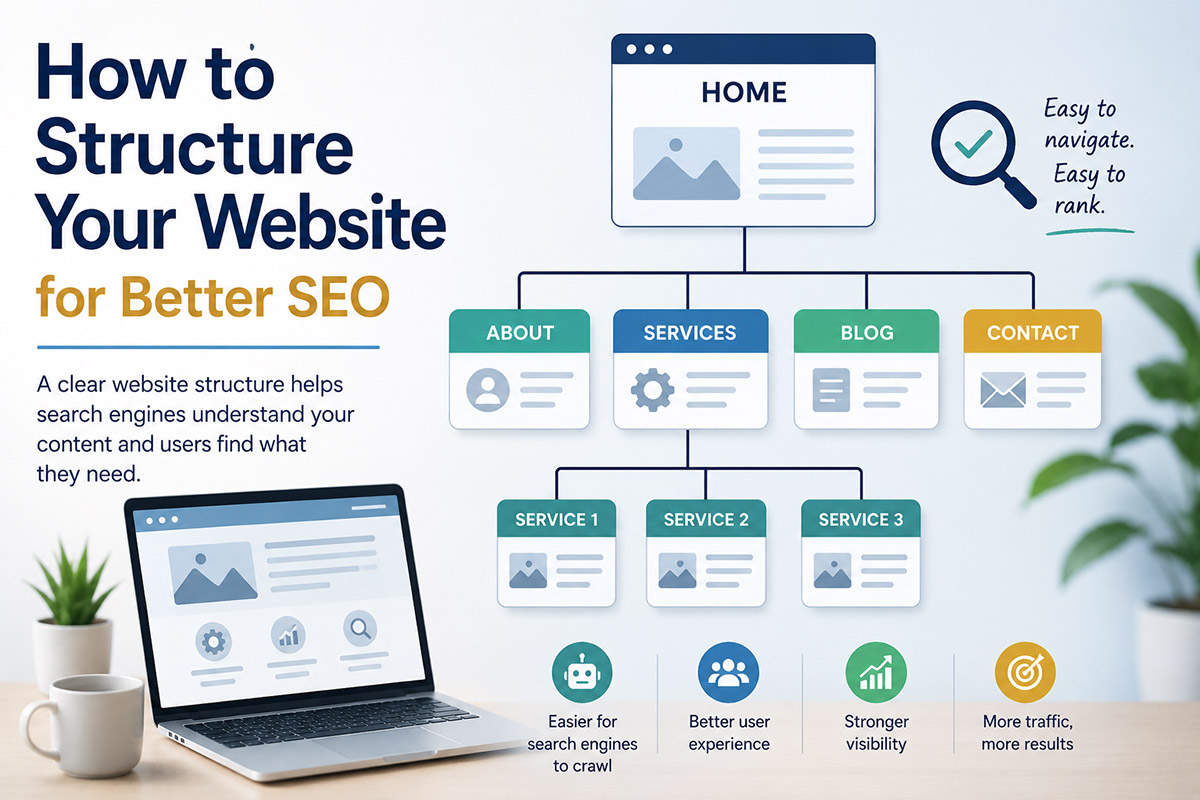
Why a well-organized website helps both visitors and search engines.
Imagine walking into a supermarket where nothing is labeled.
Bread is next to the cleaning products. Fruit is in three different aisles. The checkout is hidden somewhere in the back.
You’d probably leave.
Websites aren’t much different.
When your pages are difficult to navigate or scattered without any clear structure, visitors struggle to find what they’re looking for. Search engines and AI tools face the same problem.
Website structure isn’t the most exciting part of SEO, but it’s one of the foundations everything else is built on.
If your site is organized logically, it’s easier to crawl, easier to understand, and easier to rank.
What Is Website Structure?
Website structure simply refers to how your pages are organized and connected.
Think of it as the blueprint of your website.
For example, a bakery’s website might look something like this:
Home
→ Cakes
→ Bread
→ Catering
→ Baking Workshops
→ About
→ Contact
Each main page can then have supporting pages underneath it.
For example:
Cakes
→ Birthday Cakes
→ Wedding Cakes
→ Custom Cake Designs
This creates a clear hierarchy that makes sense to both visitors and search engines.
Why Website Structure Matters for SEO
Good website structure helps search engines discover your content more efficiently.
When Google’s crawlers visit your website, they follow links from page to page.
If your pages are well connected, they’re easier to find and index.
If important pages are buried several clicks deep or aren’t linked from anywhere, search engines may treat them as less important.
Good structure also improves the user experience.
People spend less time trying to find information and more time engaging with your content.
And that’s exactly what search engines want to see.
1. Start With Your Main Topics
One mistake I often see is businesses creating pages whenever a new idea comes to mind.
Over time, the navigation becomes cluttered.
Instead, start by identifying the main topics your business revolves around.
For our bakery, that might be:
- Cakes
- Bread
- Catering
- Workshops
For a plumber, it could be:
- Emergency Plumbing
- Bathroom Installations
- Leak Detection
- Drain Cleaning
Every additional page should fit naturally within one of those categories.
This makes your website easier to expand over time because every new page already has a logical place within your site structure.
2. Keep Navigation Simple
Just because you can have twenty menu items doesn’t mean you should.
Your main navigation should help visitors quickly understand what your business offers.
Ask yourself:
Can a first-time visitor understand my services within ten seconds?
If the answer is no, simplify.
In many cases, fewer menu items actually create a better experience.
Keep Your URLs Clear Too
Your URLs should reflect the structure of your website.
A short, descriptive URL is easier for both visitors and search engines to understand than one filled with random numbers or unnecessary words.
For example:
✅ yourwebsite.com/baking-workshops
is much clearer than:
❌ yourwebsite.com/page?id=123
or
❌ yourwebsite.com/services-new-final2
A good URL is simple, descriptive, and gives people a clear idea of what they’ll find on the page before they even click.
3. Use Internal Links Strategically
Your navigation isn’t the only thing connecting your pages.
Internal links are just as important.
Imagine you’ve written a blog post called How to Choose the Perfect Wedding Cake. Within that article, you naturally link to your Wedding Cakes page.
That’s helpful for your readers.
It also tells search engines those pages are closely related.
The more relevant connections your website has, the easier it becomes for search engines to understand your expertise on a topic.
Internal linking becomes even more powerful when you create what’s known as a topic cluster. Instead of publishing unrelated blog posts, write several articles around one main subject and link them together.
For example, if your business focuses on SEO, you might have articles about on-page SEO, user experience, website structure, keyword research, and AI search optimization. Individually, each article provides value. Together, they demonstrate expertise on the topic and make it easier for both search engines and AI tools to understand what your website is about.
That’s one of the reasons I continue to expand the SEO section on this website. Each new article strengthens the others.
Also Read: How to Write Blog Posts that Show Up in AI Results
4. Avoid Orphan Pages
An orphan page is exactly what it sounds like.
It’s a page that exists on your website but isn’t linked from anywhere else.
That means visitors are unlikely to find it.
Search engines may also struggle to discover it.
Every important page should be reachable through your navigation, category pages, or internal links.
If a page is valuable, make sure it’s connected.
5. Think Beyond Google
A few years ago, website structure mainly helped search engines crawl your site.
Today, it does much more than that.
AI tools have become another way people discover businesses and information.
Whether someone is searching on Google, asking ChatGPT a question, or using another AI-powered search tool, clear website structure makes your content easier to interpret.
Pages with logical headings, descriptive URLs, and clear relationships are simply easier for AI systems to understand.
That’s another reason why good structure is no longer just an SEO best practice.
It’s becoming an AEO best practice too.
A Simple Website Structure Most Small Businesses Can Follow
For many businesses, something like this works well:
Home
About
Services
- Service A
- Service B
- Service C
Blog
Contact
Then use your blog to answer the questions potential customers are already asking.
Each article can link back to the relevant service page, helping both visitors and search engines understand the relationship between your content.
Common Website Structure Mistakes
Here are a few issues I regularly come across:
- Creating multiple pages targeting the same keywords.
- Putting every page directly in the main menu.
- Publishing blog posts without linking to related pages.
- Using vague page titles.
- Having pages that are impossible to find.
Fortunately, these are usually straightforward to fix.
A Well-Structured Website Benefits Everyone
A well-organized website doesn’t just help Google.
It helps your visitors.
It helps AI tools understand your content.
And it helps you grow your authority around the topics that matter to your business.
If someone can quickly find what they’re looking for, they’re more likely to stay on your site, trust your business, and take the next step.
That’s exactly what good SEO should achieve.
Need Help Improving Your Website Structure?
Whether you’re launching a new website or improving an existing one, getting the structure right from the start can save a lot of time later.
At A to Z Marketing, I help businesses build websites that are easy to navigate and optimized for both search engines and AI-powered search. Because great SEO isn’t just about individual pages. It’s about how your entire website works together.
Also Read: